


Fred Hollows - Australian Ophthalmologist - Doctor

Frederick Cossom "Fred" Hollows, AC was a New Zealand and Australian ophthalmologist who became known for his work in restoring eyesight for countless thousands of people in Australia and many other countries.
Hollows
was married twice: in 1958 to Mary Skiller, who died in 1975, and in 1980 to
Gabi O'Sullivan.
Fred and Gabi married in 1980 and they had five children – Cam, Emma, Anna-Louise and twins Rosa and Ruth. Fred had two older children – Tanya and Ben – from his previous relationships.
It has
been estimated that more than one million people in the world can see today
because of initiatives instigated by Hollows, the most notable example being
The Fred Hollows Foundation.
(Source
Wikipedia)
| Quick Facts Name: Frederick Cossom "Fred" Hollows Born: 9 April 1929, Dunedin, New Zealand Died: 10 February 1993, Sydney Australia |
 |
 YouTube: Meet Fred Hollows...(URL:
https://youtu.be/rmSdt8uZ5qI)
YouTube: Meet Fred Hollows...(URL:
https://youtu.be/rmSdt8uZ5qI)
Fred Hollows was one of the four children in his family, the others being Colin, John and Maurice. All were born in Dunedin, New Zealand, to Joseph and Clarice (Marshall) Hollows. The family lived in Dunedin for the first seven years of his life.

(Source:
The Fred Hollows Foundation)
Education & Training:
He had
one year of informal primary schooling at North East Valley Primary School
and began attending Palmerston North Boys' High School when he was 13.
Hollows received his BA degree from Victoria University of Wellington.
He
briefly studied at a seminary, but decided against a life in the clergy.
After observing the doctors at a mental hospital during some charity work,
he instead enrolled at Otago Medical School.
While
living in Dunedin he was an active member of the New Zealand Alpine Club and
made several first ascents of mountains in the Mount Aspiring/Tititea region
of Central Otago.
In 1961 he went to Moorfields Eye Hospital in England to study Ophthalmology. He then did post-graduate work in Wales before moving to Australia in 1965 where he became Associate Professor of Ophthalmology at the University of New South Wales in Sydney.
From
1965–1992 he chaired the Ophthalmology division
overseeing the teaching departments at the University of New South Wales,
and the Prince of Wales and Prince Henry hospitals.
(Source:
Wikipedia)
 |
In the early 1990s, Fred and Dr Ruit began
working together towards building a world-class Introcular
lenses [IOL] manufacturing
facility in Nepal. The high cost of the intraocular lenses (IOLs) used in modern cataract surgery, put IOL implant surgery out of reach of most people in developing countries. Fred changed that... In 1994, one year after Fred’s death, the Fred Hollows IOL Laboratory at the Tilganga Eye Centre in Kathmandu began making high quality low-cost IOLs. Today the laboratory has produced well over 2 million IOLs and is one of six divisions within what is now the Tilganga Institute of Ophthalmology (TIO) – an international standard, tertiary-level eye care hospital and one of The Fred Hollows Foundation’s most valued partners. |
Employment:
- Fred had done an eye term at medical school and, as a result, he assisted eye surgeons at Auckland Public Hospital in his first job after graduating.
- In his second job, at Tauranga Public Hospital, he
made a deal with the eye surgeon to see all his eye cases and take notes
and assist in the operations. In exchange, Fred took some of the
surgeon’s ear, nose and throat cases. By the end of that year, Fred was
doing cataracts himself and finding eye medicine more and more
interesting. Ophthalmology was a trade he described as not especially
prestigious, but “good work”.
He took an ophthalmology job at Wellington, the biggest hospital in the country [NZ] - Fred
decided he needed a diploma from the Moorfields Eye Hospital Institute
of Ophthalmology in the UK, and it looked like it might be necessary to
qualify as a fellow in the specialty after that, so lots of time and
money was needed.
He worked as a general practitioner for a year to fund the move, “incredibly hard work – one weekend off in five – but very interesting,” and also worked as the ship’s doctor on the way over, six weeks via the Panama Canal, “one of the sweetest times of my life”. Once in London and studying he worked at night as a “radio doctor” on call, zipping about London in the snow in a Mini Minor.
- Studying for the
Fellowship Primary at the Royal College of Surgeons in the early 1960s
was the most intellectually expanding period of Fred’s life.
- He passed the notoriously
tough Primary exam first go and got a job in Cardiff in Wales as an
ophthalmology registrar in the Royal Infirmary.
- In 1965 Fred moved to
Australia to become Associate Professor of Ophthalmology at the
University of New South Wales (UNSW) in Sydney.
- From 1965 to 1992, he was the head of the Ophthalmology department, overseeing the teaching at UNSW and the Prince of Wales and Prince Henry hospitals. In his first year, he set up a small eye unit at the Prince of Wales Hospital and performed the hospital’s first cataract extraction. (Source: The Fred Hollows Foundation)
- In
1985, as a consultant to the World Health Organization, Fred visited
Nepal, Burma, Sri Lanka, India and Bangladesh on short-term assignments.
Two years later he visited war-torn Eritrea and saw doctors operating in
hospitals dug into mountains as the war raged above.
These experiences had a huge effect on Fred and, in line with his basic belief in “equity between people”, he started to work towards reducing the cost of eye health care and treatment in developing countries. (Source: The Fred Hollows Foundation)
Treating trachoma
Fred Hollows was a passionate campaigner for the need to improve the health
of Indigenous Australians. He was particularly concerned about the number of
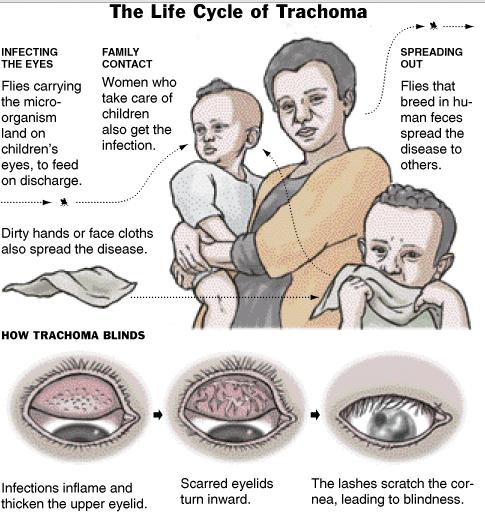
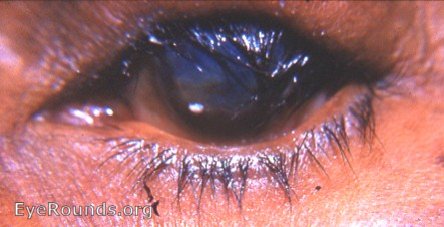
people who suffered from trachoma. Trachoma is a form of conjunctivitis
caused by infection with the bacterial microbe Chlamydia trachomatis.
It causes scarring and can lead to blindness if left untreated. Poverty, crowded living conditions and lack of water contribute to the spread of trachoma.

(Source:
Health Foxx)

(Source:
WebEye)
Fred Hollows was a passionate campaigner for the need to improve the health
of Indigenous Australians. He was particularly concerned about the number of
people who suffered from trachoma. Trachoma is a form of conjunctivitis
caused by infection with the bacterial microbe Chlamydia trachomatis. It
causes scarring and can lead to blindness if left untreated. Poverty,
crowded living conditions and lack of water contribute to the spread of
trachoma.
The National Trachoma and Eye Health Program sent teams of ophthalmologists
and support staff to communities in regional and outback Australia. The
program was supported by the Commonwealth Government and the Royal
Australasian College of Ophthalmologists and was headed by Hollows from 1976
to 1978.
The program tested and treated people for eye diseases, especially trachoma
and cataracts. More than 100,000 people, of whom 62,000 were Indigenous,
were screened.
Nearly half of Australia's Indigenous population was found to have trachoma
and in some regions of the Northern Territory and Western Australia the rate
was 80 per cent. (Source:
NMA)
Experiences & Opportunities:
|
Why
was Fred an Australian Legend?
|


YouTube: Fred Hollows and Dr Ruit challenged the ophthalmic world
(URL:
https://youtu.be/vNoK_CdpmrU)
YouTube: 'Shine On' TV Ad - Fred showed us the way, now it's up to
us
(URL:
https://youtu.be/k2opo45uPzk)
YouTube: Fred Hollows on 60 Minutes:
Archive
(URL:
https://youtu.be/DnrM58c466Y)
His Death
Hollows died in Sydney, New South
Wales, Australia in 1993 at the age of 63. The cause of his death was
metastatic renal cancer primarily affecting his lungs and brain. He had been
diagnosed with the disease six years earlier, in 1987.
Hollows was given a state funeral service at St Mary's Cathedral in Sydney,
though he was an atheist, and, in accordance with his wishes, was interred
in Bourke, where he had worked in the early 1970s.
 |
 |
|
Did You Know? Honours
|

Links:
|
Young
Fred Hollows - The Fred Hollows Foundation |
The
Australian Government: Fred Hollows |
ABC:
Talking Heads |
Racism
No Way: Fred Hollows |
Indigenous
Eye Health
 Primary
 Middle
  Secondary
 Australian
Curriculum General Capability:
Information and Communication Technology Capability
Australian
Curriculum General Capability:
Information and Communication Technology Capability
 Australian
Curriculum General Capability:
Critical and creative thinking
Australian
Curriculum General Capability:
Critical and creative thinking
 Australian
Curriculum General Capability:
Personal and social capability
Australian
Curriculum General Capability:
Personal and social capability
 Australian
Curriculum General Capability:
Literacy
Australian
Curriculum General Capability:
Literacy
 Australian
Curriculum Cross Curriculum Priorities:
Aboriginal and Torres Strait Islander histories and cultures
Australian
Curriculum Cross Curriculum Priorities:
Aboriginal and Torres Strait Islander histories and cultures
 Cooperative
Learning Activity
Cooperative
Learning Activity
Background
Nationally, eye and vision health issues: are responsible for 11% of years of life lost to disability (YLD) for Indigenous people; constitute the fourth leading cause of the gap in health between Indigenous and non-Indigenous people; and increase mortality at least two-fold.
Around 94% of vision loss among Indigenous people nationally is preventable or treatable, with the leading eye conditions being cataract, refractive error, optic atrophy, diabetic retinopathy, and trachoma. (Source: Australian Indigenous Health Info Net)
1. In pairs, you are to set up a Social Media story about the work of Fred Hollows with Indigenous Australians using one of the Social Media programmes found here.
You might also want to use the Fred Hollows Foundation!
The Fred Hollows Foundation - Who We Are
https://youtu.be/Vj4_Z9eoPIE
2. Go to the Social Media page to select one of the programmes listed there.
3. Become an advocate to the Federal Government for more help for Indigenous Australians and close the gap in health care. What will be your angle?
Material sourced from
The Fred Hollows Foundation
- About Fred
Health Foxx
NMA
Wikipedia


Copyright © On the Job Online


